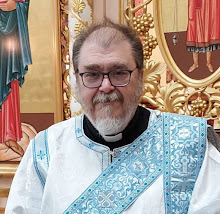
Liturgical Norms: Our Keys to Spiritual Nourishment, Evangelization and Unity
Posted using ShareThis
Showing posts with label Roman Rite. Show all posts
Showing posts with label Roman Rite. Show all posts
Wednesday, August 20, 2008

Tuesday, July 01, 2008
Benedictus Antiphon for July 3
John 20:29 Because thou hast seen me, Thomas, thou hast believed: blessed are they that have not seen and have believed.
Quia vidisti me, Thoma
KWEE-ah vee-DEE-stee may, TOH-mah
because you-have-seen me, Thomas
Credidisti.
kray-dee-DEES-tee.
you-have-believed.
Beati qui non viderunt
bay-AH-tee kwee nohn vee-DAY-roont
blessed-ones who not they-have-seen
et crediderunt.
ayt cray-dee-DAY-roont.
and they-have-believed.
Did you know that, if you're a Christian, that you are a priest?
Before God had even given them the Ten Commandments, He had told the Israelites that he would make of them a nation of Priests and Kings.
Later, in his first Epistle, St. Peter wrote to us that we are "A chosen generation, a Royal Priesthood".
Part of what that means is making intercession for the world. And we have our own sacrificial liturgy, the Liturgy of the Hours, where we offer the sacrifice of praise.
We can pray it in Latin or in English.
If you don't have it, you can get it at http://store.PrayInLatin.com
Your purchase helps me continue my work teaching the Church's language.
Lou
Quia vidisti me, Thoma
KWEE-ah vee-DEE-stee may, TOH-mah
because you-have-seen me, Thomas
Credidisti.
kray-dee-DEES-tee.
you-have-believed.
Beati qui non viderunt
bay-AH-tee kwee nohn vee-DAY-roont
blessed-ones who not they-have-seen
et crediderunt.
ayt cray-dee-DAY-roont.
and they-have-believed.
Did you know that, if you're a Christian, that you are a priest?
Before God had even given them the Ten Commandments, He had told the Israelites that he would make of them a nation of Priests and Kings.
Later, in his first Epistle, St. Peter wrote to us that we are "A chosen generation, a Royal Priesthood".
Part of what that means is making intercession for the world. And we have our own sacrificial liturgy, the Liturgy of the Hours, where we offer the sacrifice of praise.
We can pray it in Latin or in English.
If you don't have it, you can get it at http://store.PrayInLatin.com
Your purchase helps me continue my work teaching the Church's language.
Lou
Friday, June 27, 2008
Offertory for 6/29/2008
Daniel 3. Like as in the burnt offerings of rams and bullocks, and like as in ten thousands of fat lambs: so let our sacrifice be in thy sight this day, that it may please thee: for they shall not be confounded that put their trust in thee, O Lord.
Sicut in holocausto arietum et taurorum,
SEE-koot een hoh-loh-COW-stoh ah-REE-ay-toom ayt tah-oo-ROH-room
like in burnt-offering of-rams and of-bulls
et sicut in millibus agnorum pinguium:
ayt SEE-koot een MEEL-lee-boos ahn-YOH-room PEEN-gwee-oom
and like in ten-thousands of-lambs of-fat
sic fiat sacrificium nostrum
seek FEE-aht sahk-ree-FEE-chee-oom NOHS-troom
so let-it-be sacrifice ours
in conspectu tuo hodie, ut placeat tibi:
een kohn-SPAYK-too TOO-oh HOH-dee-ay, oot PLAH-chay-aht TEE-bee
in sight thine today, that it-might-be-pleasing to-thee
quia non est confusio confidentibus
KWEE-ah nohn ayst kohn-FOO-see-oh kohn-fee-DAYN-tee-boos
for not is confusion to-those-putting-trust
in te Domine
een tay, DOH-mee-nay
in thee, Lord
Sicut in holocausto arietum et taurorum,
SEE-koot een hoh-loh-COW-stoh ah-REE-ay-toom ayt tah-oo-ROH-room
like in burnt-offering of-rams and of-bulls
et sicut in millibus agnorum pinguium:
ayt SEE-koot een MEEL-lee-boos ahn-YOH-room PEEN-gwee-oom
and like in ten-thousands of-lambs of-fat
sic fiat sacrificium nostrum
seek FEE-aht sahk-ree-FEE-chee-oom NOHS-troom
so let-it-be sacrifice ours
in conspectu tuo hodie, ut placeat tibi:
een kohn-SPAYK-too TOO-oh HOH-dee-ay, oot PLAH-chay-aht TEE-bee
in sight thine today, that it-might-be-pleasing to-thee
quia non est confusio confidentibus
KWEE-ah nohn ayst kohn-FOO-see-oh kohn-fee-DAYN-tee-boos
for not is confusion to-those-putting-trust
in te Domine
een tay, DOH-mee-nay
in thee, Lord
Tuesday, June 24, 2008
Singing the Divine Office
Last year, I spoke of the dearth of materials available for singing the Liturgy of the Hours.
Well, that situation hasn't changed much.
So, I figured the best thing to do is make the chant of the old office available in print.
This past week, I have republished the Antiphonarium Ordinis Prædicatorum (the Antiphonary of the Order of Preachers) and the 1911 Antiphonale Romanum (Roman Antiphonal). The Roman Antiphonal contains all the chant necessary to sing the day hours of the 1962 Roman Breviary, which is currently approved by Rome for those who prefer the older, Extraordinary Form of the Roman Mass.
Both can be ordered at http://lulu.ByzantineDominican.com
Cantemus Domino - Let us Sing to the Lord.
Lou
Well, that situation hasn't changed much.
So, I figured the best thing to do is make the chant of the old office available in print.
This past week, I have republished the Antiphonarium Ordinis Prædicatorum (the Antiphonary of the Order of Preachers) and the 1911 Antiphonale Romanum (Roman Antiphonal). The Roman Antiphonal contains all the chant necessary to sing the day hours of the 1962 Roman Breviary, which is currently approved by Rome for those who prefer the older, Extraordinary Form of the Roman Mass.
Both can be ordered at http://lulu.ByzantineDominican.com
Cantemus Domino - Let us Sing to the Lord.
Lou
Offertory Antiphon for Solemnity of Sts Peter and Paul, Graduale Simplex
One of the often ignored jewels of Gregorian Chant which came out of the decrees of the Second Vatican Council is the Graduale Simplex, or Simple Gradual. This is the Communion Antiphon for the Solemnity of Sts. Peter and Paul, which we celebrate this Sunday.
Tu es Petrus, et super hanc petram ædificabo Ecclesiam meam.
You are Peter, and upon this rock I will build my church
Tu es Petrus,
too ays PAY-troos
Thou art Peter
et super hanc petram
ayt SOO-payr hahnk PAY-trahm
and upon this rock
ædificabo Ecclesiam meam.
ay-dee-fee-KAH-boh ay-KLAY-see-ahm MAY-ahm
I-will-build Church mine.
For more prayers like this, including the Rosary and the Ordinary of the Mass, visit
http://lulu.byzantinedominican.com/
Tu es Petrus, et super hanc petram ædificabo Ecclesiam meam.
You are Peter, and upon this rock I will build my church
Tu es Petrus,
too ays PAY-troos
Thou art Peter
et super hanc petram
ayt SOO-payr hahnk PAY-trahm
and upon this rock
ædificabo Ecclesiam meam.
ay-dee-fee-KAH-boh ay-KLAY-see-ahm MAY-ahm
I-will-build Church mine.
For more prayers like this, including the Rosary and the Ordinary of the Mass, visit
http://lulu.byzantinedominican.com/
Monday, July 09, 2007
Summorum Pontificum - What does it mean?
With the long awaited release of the Motu Proprio Summorum Pontificum, there is much confusion in the reporting on it, even from otherwise solid catholic sources.
So let's review a little bit.
1) The Tridentine and Novus Ordo liturgies are no longer to be considered different rites, but different uses of the same rite (just as the liturgy approved for Anglican converts is not an Anglican Rite, but rather the Anglican use of the Roman Rite). Why is this important? First and foremost, it states in no uncertain terms that the Novus Ordo is not some new departure, but is the ROMAN RITE, which will (hopefully) cut down - or eliminate - the abuses that have occured in the last 37 years.
2) There is no longer a need for the faithful - or priests - attached to the 1962 Missal(i.e., the traditional use) to go begging their Bishop to allow them to worship God in this fashion. Any priest may offer it as a private mass, and any pastor may allow it in his parish.
3) The 1962 Breviary is allowed for those in orders and for those who are expected to pray a valid form of the Divine Office.
4) Contrary to reports, the Good Friday prays for the Conversion of the Jews are not reinstated; they were deleted prior to the 1962 Missal.
5) Contrary to reports, Latin is not forbidden during the Triduum (it has always been licit to say the Novus Ordo in Latin). Neither is the 1962 Missal forbidden during the Triduum. What is forbidden is the celebration of private Masses according to the 1962 Missal during the Triduum.
6) Parishes may now be established which celebrate accordign to the 1962 Missal.
Many have suggested that this Motu Proprio was a move on the part of Benedict XVI aimed at reconciling the Society of St. Pius X. Personally, I doubt it. He has stated that a priest who celebrates according to the 1962 Missal may not reject the possibility (and therefore the validity) of celebrating according to the 1970 Missal. SSPX certainly will never agree to this.
No, this is not an olive branch to the Traditionalist who have left the Church to wallow in their own dissention. It is an encouragement to those of us who believe that the faith of Vatican II is the faith of Nicea; who believe that the Roman Mass is centered on Christ, not Man.
Papa Benedicte, tibi gratias agimus. Semper te benedicat Dominus noster, Jesus Christus.
So let's review a little bit.
1) The Tridentine and Novus Ordo liturgies are no longer to be considered different rites, but different uses of the same rite (just as the liturgy approved for Anglican converts is not an Anglican Rite, but rather the Anglican use of the Roman Rite). Why is this important? First and foremost, it states in no uncertain terms that the Novus Ordo is not some new departure, but is the ROMAN RITE, which will (hopefully) cut down - or eliminate - the abuses that have occured in the last 37 years.
2) There is no longer a need for the faithful - or priests - attached to the 1962 Missal(i.e., the traditional use) to go begging their Bishop to allow them to worship God in this fashion. Any priest may offer it as a private mass, and any pastor may allow it in his parish.
3) The 1962 Breviary is allowed for those in orders and for those who are expected to pray a valid form of the Divine Office.
4) Contrary to reports, the Good Friday prays for the Conversion of the Jews are not reinstated; they were deleted prior to the 1962 Missal.
5) Contrary to reports, Latin is not forbidden during the Triduum (it has always been licit to say the Novus Ordo in Latin). Neither is the 1962 Missal forbidden during the Triduum. What is forbidden is the celebration of private Masses according to the 1962 Missal during the Triduum.
6) Parishes may now be established which celebrate accordign to the 1962 Missal.
Many have suggested that this Motu Proprio was a move on the part of Benedict XVI aimed at reconciling the Society of St. Pius X. Personally, I doubt it. He has stated that a priest who celebrates according to the 1962 Missal may not reject the possibility (and therefore the validity) of celebrating according to the 1970 Missal. SSPX certainly will never agree to this.
No, this is not an olive branch to the Traditionalist who have left the Church to wallow in their own dissention. It is an encouragement to those of us who believe that the faith of Vatican II is the faith of Nicea; who believe that the Roman Mass is centered on Christ, not Man.
Papa Benedicte, tibi gratias agimus. Semper te benedicat Dominus noster, Jesus Christus.
Thursday, June 28, 2007
Misconceptions about Tridentine Mass
The word is that the long awaited Motu Proprio liberalizing the celeberation of the traditional Latin Rite Mass, AKA the Tridentine Mass or the 1962 Missal, will be issued on July 7.
However, in reading the news reports, one cannot but be struck by the ignorance regarding this Mass and the Vatican II reforms.
However, in reading the news reports, one cannot but be struck by the ignorance regarding this Mass and the Vatican II reforms.
- Vatican II never, ever, forbade the use of Latin. In fact, the Conciliar Document dealing with the Liturgy stresses that, while the vernacular be permitted in parts of the Mass, Latin be maintained as the language of the Mass.
- Vatican II never, ever, mandated that the priest face the people. In fact, it never suggested it.
- In the Tridentine Mass, the priest doesn't necessarily face away from the people; the priest faces east, towards the rising sun, because Christ is the Sun of Righteousness. Accordingly, most Catholic church are traditionally built so that the priest and the people both face east. Within this symbolism, the priest facing the people is symbolically turning his back on Christ (but, I hope, this is not truly the case in the heart of the priest). However, at St Peters Basilica in the Vatican, when the priest faces east, he is facing the people.
- The new Liturgy, the Novus Ordo, can be celebrated in Latin. Indeed, watch any Mass from the Vatican, and Latin is indeed the language. All of the typical editions of the various liturgical books are all in Latin.
- The Tridentine Mass need not be celebrated in Latin; the 1965 Missal, which was a direct result of the Council, has this Mass in the Vernacular. However, I doubt that this usage will be included in the Motu Proprio.
Monday, June 25, 2007
The Vatican's Abandoment of the Divine Office
The further I delve into the study of chant, the more I realize that the Church does little more than give lip service to the public celebration of the Divine Office, the Liturgy of the Hours.
Why do I say this?
1) Consider the fact that, 20 years after the publication of the second edition of the LOTH, there is still no official english translation of it. The official translation of the 1974 edition is so poorly presented that, unless one is a liturgical scholar, knowing which texts to select becomes an exercise in futility. And the psalm translation used is presented in such a way that it is far from conducive to the use of Gregorian Chant.
2) Consider the fact that, 30+ years after the new Office's official promulgation, it is rare to hear it even recited at the parish level. In November 1995, newly received into the Catholic Church, I wrote to the local Latin Ordinary, reminding him of section 100 of Sacrosanctum Concilium: “Pastors of souls should see to it that the chief hours, especially Vespers, are celebrated in common in church on Sundays and the more solemn feasts. ” He wrote back to me, suggesting that I speak to the rector and organist of the Cathedral. I did that, and, although I spent the next 2-1/2 years as a cantor there, there was never a celebration of the Vespers, let alone any other hour. The reason? In the words of the rector, “We have to find the right time to do it.” When is not the right time to pray?
3) Consider the fact that no chant has been officially promulgated for the antiphons in the new office. Yes, Liber Hymnarius, vol. 2 of the new Antiphonale Romanum has been published, and, thankfully, contains many newly recovered old Latin hymns (but, again, not english translation is yet available, after 24 years). But there is no music for the antiphons. Contrast this with the last major reform of the Office, Pius X's Breviarium Romanum of 1911. The companion Antiphonale Romanum was published in 1912 - the next year.
As to the Eastern Catholic Churches, I cannot say for sure. I know that my own parish does not regularly celebrate the Office; Great Compline on Christmas Eve, Great Friday Matins (on Thursday evening), Great Friday Vespers, Jerusalem Matins, and an abbreviated Paschal Matins is the extent of it.
If the Divine Office is indeed the prayer of the Church, why is it not better promoted?
If the Divine Office is the means whereby the Royal Priesthood is exercised, why is it not better promoted?
Why don't the Catholic Churches truly support this gift from God?
Why do I say this?
1) Consider the fact that, 20 years after the publication of the second edition of the LOTH, there is still no official english translation of it. The official translation of the 1974 edition is so poorly presented that, unless one is a liturgical scholar, knowing which texts to select becomes an exercise in futility. And the psalm translation used is presented in such a way that it is far from conducive to the use of Gregorian Chant.
2) Consider the fact that, 30+ years after the new Office's official promulgation, it is rare to hear it even recited at the parish level. In November 1995, newly received into the Catholic Church, I wrote to the local Latin Ordinary, reminding him of section 100 of Sacrosanctum Concilium: “Pastors of souls should see to it that the chief hours, especially Vespers, are celebrated in common in church on Sundays and the more solemn feasts. ” He wrote back to me, suggesting that I speak to the rector and organist of the Cathedral. I did that, and, although I spent the next 2-1/2 years as a cantor there, there was never a celebration of the Vespers, let alone any other hour. The reason? In the words of the rector, “We have to find the right time to do it.” When is not the right time to pray?
3) Consider the fact that no chant has been officially promulgated for the antiphons in the new office. Yes, Liber Hymnarius, vol. 2 of the new Antiphonale Romanum has been published, and, thankfully, contains many newly recovered old Latin hymns (but, again, not english translation is yet available, after 24 years). But there is no music for the antiphons. Contrast this with the last major reform of the Office, Pius X's Breviarium Romanum of 1911. The companion Antiphonale Romanum was published in 1912 - the next year.
As to the Eastern Catholic Churches, I cannot say for sure. I know that my own parish does not regularly celebrate the Office; Great Compline on Christmas Eve, Great Friday Matins (on Thursday evening), Great Friday Vespers, Jerusalem Matins, and an abbreviated Paschal Matins is the extent of it.
If the Divine Office is indeed the prayer of the Church, why is it not better promoted?
If the Divine Office is the means whereby the Royal Priesthood is exercised, why is it not better promoted?
Why don't the Catholic Churches truly support this gift from God?
Tuesday, June 19, 2007
Devil Especially Hates Prayers In Latin, Says A Priest Known As 'Rome's Exorcist
This is from Spirit Daily originally appearing on May 30, 2007, and is used by permission.
_________________________________________
A secular book about exorcism says that one thing rankles demons.
"The devil doesn't like Latin," writes Tracy Wilkinson in The Vatican's Exorcists. "That is one of the first things I learned from Father Gabriele Amorth, long known as Rome's chief exorcist, even though that has never been his formal title.
"Now past the age of eighty, Father Amorth has dedicated the last decades of his life to regaining a measure of respectability for exorcism. Despite his advancing age, he continues to perform the rite several times a week at his office in Rome.
"Scores of people seek him out. He prefers to use Latin when he conducts exorcisms, he says, because it is most effective in challenging the devil."
That tidbit comes to us at a time when Benedict XVI is ready to loosen restrictions on Latin Mass. It's in the new book -- a secular and sometimes skeptical but fascinating glimpse into the world of Italian priests who see their job as casting out demons.
While the numbers dwindle in countries like the Canada, France, and the U.S., exorcists are on the rise on the Vatican's home turf -- thanks largely to priests such as Father Amorth.
In Italy the number of exorcists has grown tenfold in the past decade, according to the priest (who is himself author of two bestsellers, An Exorcist Tells His Story and An Exorcist: More Stories). Credit is also due to the legacy of John Paul II -- who made the notion of exorcism, which was founded by Jesus Himself, respectable again.
Father Amorth was born in Modena in northern Italy and has been a priest since 1954. In 1986 he began performing exorcisms under the tutelage of the vicar for Rome.
According to Wilkinson, Father Amorth accepted the task "after praying to the Virgin Mary for her steadfast guidance and protection."
"On the walls of Amorth's exorcism chamber, eight Crucifixes and pictures of the Madonna are hanging, plus a picture of Saint Michael the Archangel," says the book. "A two-foot-high statue of the Virgin Mary, the Madonna of Fatima, sits on a corner table.
"There are also pictures of the late Pope John Paul II; the popular saint Padre Pio; Amorth's mentor, Father Candido; and Father Giacomo Alberione, the founder of the Society of Saint Paul Congregation."
Father Amorth them "my protectors," adding that "the more recent addition of John Paul's has been especially effective and helpful."
"The demons become very agitated at his presence," Father Amorth says of the late Pope -- who himself performed several exorcisms during his pontificate and warned of the rise of dark forces both in 1977 and then in 2005 just days before he lapsed in his final bout with illness.
How is exorcism done? There is the Crucifix. There is the Holy Water. There are the ritual prayers. Many times, those afflicted have to come back on a regular basis -- the process a gradual one.
In Father Amorth's appointment book, women outnumber men by three to one. That is perhaps because they are more in tune with the spiritual, says the exorcist, or because they are special targets as the descendants of Eve.
The very word "hysteria" -- so often seen in the possessed -- comes from the Greek word hyster for womb. Greeks believed it was caused by abnormalities in the uterus.
"I maintain that in part, the reason is because women are the ones who do the most praying," says the priest. "Another reason is women are more inclined to approach a priest than are men, in case of need."
In some cases, say other exorcists, the devil attempts to mask possession as insanity. This sets up conflict with the far newer practice of psychology -- which looks down on exorcism as the psychiatrist's couch has replaced the confessional.
"An exorcism is the residue of a medieval practice completely devoid of any foundation in reason," the book quotes Sergio Moravia, a philosopher at the University of Florence, as saying. "I don't think it's crazy. It's worse."
Exorcists counter that psychological diagnoses such as "multiple personality" and "schizophrenia" are clinical covers for an infestation.
That opinion is shared by the many who have sought the services of Father Amorth -- finding relief when the devil was cast away after years of frustration at the hands of psychiatrists who saw their problems so differently.
Blessed salt and Holy Water are often used not just by the exorcists themselves, but by those who have been exorcised -- to stave off further disturbances.
Extraordinary strength, preternatural knowledge, speaking in foreign tongues unknown to the victim, vomiting of strange objects, and violent aversion to holy objects make pure psychological explanations suspect in strong cases.
Prayer, of course, also chases the devil and his manifestations away -- apparently, Latin in particular.
Bishop Andrea Gemma of Isernia -- who himself performs exorcisms -- ascribes the Church's move from Latin as part of a global plot to undermine Christianity.
"The devil is happy with the near-disappearance of Latin," said the bishop.
Does exorcism mask psychological illness with the supernatural, or is psychology itself a ruse, at least in certain instances, to prevent deliverance?
We have only to study the ministry of Jesus to know the answer.
[resources: The Vatican's Exorcists, An Exorcist Tells His Story, and An Exorcist: More Stories]
You can purchase my book, Pray it in Latin at PrayinLatin.com or at the Byzantine Dominican Store
_________________________________________
A secular book about exorcism says that one thing rankles demons.
"The devil doesn't like Latin," writes Tracy Wilkinson in The Vatican's Exorcists. "That is one of the first things I learned from Father Gabriele Amorth, long known as Rome's chief exorcist, even though that has never been his formal title.
"Now past the age of eighty, Father Amorth has dedicated the last decades of his life to regaining a measure of respectability for exorcism. Despite his advancing age, he continues to perform the rite several times a week at his office in Rome.
"Scores of people seek him out. He prefers to use Latin when he conducts exorcisms, he says, because it is most effective in challenging the devil."
That tidbit comes to us at a time when Benedict XVI is ready to loosen restrictions on Latin Mass. It's in the new book -- a secular and sometimes skeptical but fascinating glimpse into the world of Italian priests who see their job as casting out demons.
While the numbers dwindle in countries like the Canada, France, and the U.S., exorcists are on the rise on the Vatican's home turf -- thanks largely to priests such as Father Amorth.
In Italy the number of exorcists has grown tenfold in the past decade, according to the priest (who is himself author of two bestsellers, An Exorcist Tells His Story and An Exorcist: More Stories). Credit is also due to the legacy of John Paul II -- who made the notion of exorcism, which was founded by Jesus Himself, respectable again.
Father Amorth was born in Modena in northern Italy and has been a priest since 1954. In 1986 he began performing exorcisms under the tutelage of the vicar for Rome.
According to Wilkinson, Father Amorth accepted the task "after praying to the Virgin Mary for her steadfast guidance and protection."
"On the walls of Amorth's exorcism chamber, eight Crucifixes and pictures of the Madonna are hanging, plus a picture of Saint Michael the Archangel," says the book. "A two-foot-high statue of the Virgin Mary, the Madonna of Fatima, sits on a corner table.
"There are also pictures of the late Pope John Paul II; the popular saint Padre Pio; Amorth's mentor, Father Candido; and Father Giacomo Alberione, the founder of the Society of Saint Paul Congregation."
Father Amorth them "my protectors," adding that "the more recent addition of John Paul's has been especially effective and helpful."
"The demons become very agitated at his presence," Father Amorth says of the late Pope -- who himself performed several exorcisms during his pontificate and warned of the rise of dark forces both in 1977 and then in 2005 just days before he lapsed in his final bout with illness.
How is exorcism done? There is the Crucifix. There is the Holy Water. There are the ritual prayers. Many times, those afflicted have to come back on a regular basis -- the process a gradual one.
In Father Amorth's appointment book, women outnumber men by three to one. That is perhaps because they are more in tune with the spiritual, says the exorcist, or because they are special targets as the descendants of Eve.
The very word "hysteria" -- so often seen in the possessed -- comes from the Greek word hyster for womb. Greeks believed it was caused by abnormalities in the uterus.
"I maintain that in part, the reason is because women are the ones who do the most praying," says the priest. "Another reason is women are more inclined to approach a priest than are men, in case of need."
In some cases, say other exorcists, the devil attempts to mask possession as insanity. This sets up conflict with the far newer practice of psychology -- which looks down on exorcism as the psychiatrist's couch has replaced the confessional.
"An exorcism is the residue of a medieval practice completely devoid of any foundation in reason," the book quotes Sergio Moravia, a philosopher at the University of Florence, as saying. "I don't think it's crazy. It's worse."
Exorcists counter that psychological diagnoses such as "multiple personality" and "schizophrenia" are clinical covers for an infestation.
That opinion is shared by the many who have sought the services of Father Amorth -- finding relief when the devil was cast away after years of frustration at the hands of psychiatrists who saw their problems so differently.
Blessed salt and Holy Water are often used not just by the exorcists themselves, but by those who have been exorcised -- to stave off further disturbances.
Extraordinary strength, preternatural knowledge, speaking in foreign tongues unknown to the victim, vomiting of strange objects, and violent aversion to holy objects make pure psychological explanations suspect in strong cases.
Prayer, of course, also chases the devil and his manifestations away -- apparently, Latin in particular.
Bishop Andrea Gemma of Isernia -- who himself performs exorcisms -- ascribes the Church's move from Latin as part of a global plot to undermine Christianity.
"The devil is happy with the near-disappearance of Latin," said the bishop.
Does exorcism mask psychological illness with the supernatural, or is psychology itself a ruse, at least in certain instances, to prevent deliverance?
We have only to study the ministry of Jesus to know the answer.
[resources: The Vatican's Exorcists, An Exorcist Tells His Story, and An Exorcist: More Stories]
You can purchase my book, Pray it in Latin at PrayinLatin.com or at the Byzantine Dominican Store
Monday, June 18, 2007
On Sequences
God has graced me by allowing me to live my spiritual life breathing with both lungs of the Church, both east and west. And, as a cantor, one of my great joys is knowing the chant, and the liturgical propers, for both the Roman and Byzantine rites.
Two years ago, I had been approached to full an organist position at a local Roman parish. During the interview, I noted that the first Sunday that I would minister in the parish would be Pentecost, and I asked if they wanted the chant version of Veni Sancte Spiritus, or if there was a preferred hymn setting. The response I received was "O, we don't do that here". And, my immediate inward response was "and I won't minister here".
Parallelling the Byzantine Kontakion, the western Sequence (also called Prose) is an important part of the western spiritual heritage. Originating in the tenth century, or earlier, it is a liturgical hymn of praise, proclaiming the theme of the feast, sung between the Alleluia and the Gospel (the Novus Ordo places it before the Alleluia). By the time of the Council of Trent in the 16th century, there were literally hundreds of sequences.
Trent cut back the number of sequences to 4
Vatican II eliminated Dies Irae as a Mass sequence and added it to the Office as an optional hymn.
Before Vatican II, some of the Orders retained special sequences. The Dominican Gradual has sequences for St. Dominic, St. Francis, and Christmas; the Benedictine appendix to the current Roman Gradual has a sequence for St Benedict.
One can argue the wisdom of eliminating the vast majority of sequences. But the fact that these few remain make them all the more important, all the more precious. They are part of the liturgical patrimony of the west, and ought not be discarded, but cherished.
And, maybe, just maybe, would should think about singing the sequences devotionally, or perhaps before Mass. After all, Trent didn't forbid them, just took them out of their place after the Alleluia.
Two years ago, I had been approached to full an organist position at a local Roman parish. During the interview, I noted that the first Sunday that I would minister in the parish would be Pentecost, and I asked if they wanted the chant version of Veni Sancte Spiritus, or if there was a preferred hymn setting. The response I received was "O, we don't do that here". And, my immediate inward response was "and I won't minister here".
Parallelling the Byzantine Kontakion, the western Sequence (also called Prose) is an important part of the western spiritual heritage. Originating in the tenth century, or earlier, it is a liturgical hymn of praise, proclaiming the theme of the feast, sung between the Alleluia and the Gospel (the Novus Ordo places it before the Alleluia). By the time of the Council of Trent in the 16th century, there were literally hundreds of sequences.
Trent cut back the number of sequences to 4
- Victimae Paschali Laudes, for Easter
- Veni Sancte Spiritus, for Pentecost
- Lauda Sion Salvatorem, for Corpus Christi
- Dies Irae, for the Requiem
Vatican II eliminated Dies Irae as a Mass sequence and added it to the Office as an optional hymn.
Before Vatican II, some of the Orders retained special sequences. The Dominican Gradual has sequences for St. Dominic, St. Francis, and Christmas; the Benedictine appendix to the current Roman Gradual has a sequence for St Benedict.
One can argue the wisdom of eliminating the vast majority of sequences. But the fact that these few remain make them all the more important, all the more precious. They are part of the liturgical patrimony of the west, and ought not be discarded, but cherished.
And, maybe, just maybe, would should think about singing the sequences devotionally, or perhaps before Mass. After all, Trent didn't forbid them, just took them out of their place after the Alleluia.
Tuesday, October 31, 2006
Isn't Latin a dead language?
I often have people ask me, "Isn't Latin a dead language?" or "Didn't the Church outlaw Latin with Vatican II?"
In reality, nothing could be further from the truth. Yes, Latin is no longer used for everyday conversation, but it's the basis for a large part of our English vocabulary. In fact, even the word "vocabulary" has Latin roots, from "voco", to call or "vox", voice.
And the Catholic Church didn't outlaw Latin. The Vatican II Constitution on the Sacred Liturgy allows the use of the vernacular in portions of the Mass. Sadly, most bishops took that as license to abolish the language. (Of course, Latin is the language of the Roman - or Latin - Catholic Church. Other Catholic Churches in communion with Rome, such as the Ukrainian or Melkite, have never used Latin as a principle language).
So why pray in this language?
1) The saints prayed in Latin
2) The official version of most prayers is still in Latin.
3) The meaning of some prayers is often obscured by poor translations. Take for example the Gloria. The English says, "Glory to God in the highest, and peace to his people on earth." The Latin is "Gloria in excelsis Deo, et in terra pax hominibus bonae voluntatis" - "Glory to God in the highest, and on earth peace to men (or people) of good will". A small difference, but significant.
4) Knowing how to pronounce Latin properly opens up the world of Gregorian Chant, which, as the Vatican II Fathers wrote, retains the pride of place in the Liturgy. In other words, the Church teaches that the principle music in the Holy Mass is, and should remain, Gregorian Chant. Now isn't that preferable to some of the drivel that passes for liturgical music today?
In reality, nothing could be further from the truth. Yes, Latin is no longer used for everyday conversation, but it's the basis for a large part of our English vocabulary. In fact, even the word "vocabulary" has Latin roots, from "voco", to call or "vox", voice.
And the Catholic Church didn't outlaw Latin. The Vatican II Constitution on the Sacred Liturgy allows the use of the vernacular in portions of the Mass. Sadly, most bishops took that as license to abolish the language. (Of course, Latin is the language of the Roman - or Latin - Catholic Church. Other Catholic Churches in communion with Rome, such as the Ukrainian or Melkite, have never used Latin as a principle language).
So why pray in this language?
1) The saints prayed in Latin
2) The official version of most prayers is still in Latin.
3) The meaning of some prayers is often obscured by poor translations. Take for example the Gloria. The English says, "Glory to God in the highest, and peace to his people on earth." The Latin is "Gloria in excelsis Deo, et in terra pax hominibus bonae voluntatis" - "Glory to God in the highest, and on earth peace to men (or people) of good will". A small difference, but significant.
4) Knowing how to pronounce Latin properly opens up the world of Gregorian Chant, which, as the Vatican II Fathers wrote, retains the pride of place in the Liturgy. In other words, the Church teaches that the principle music in the Holy Mass is, and should remain, Gregorian Chant. Now isn't that preferable to some of the drivel that passes for liturgical music today?
Subscribe to:
Posts (Atom)